
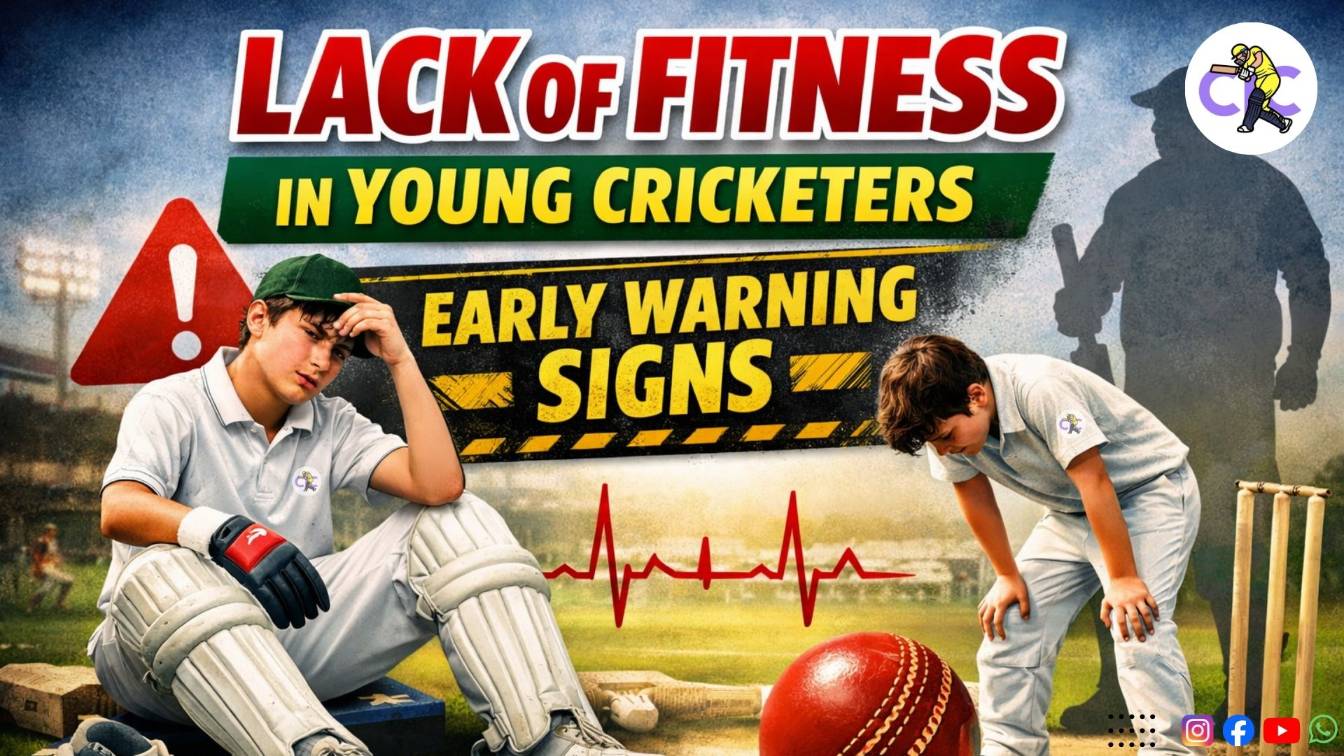

Cricket has evolved into a fast, physically demanding sport. At competitive levels, fitness is no longer optional — it is essential.
Many young cricketers possess skill and talent, but struggle because of poor physical conditioning.
Understanding early signs of fitness issues helps players correct them before they affect performance and career growth.
Also Read: Bat Swing Problems in Young Batsmen and Correct Training Methods
Why Fitness Is Critical at a Young Age
Fitness supports:
Technique consistency
Injury prevention
Mental focus
Long match performance
Without proper cricket fitness at an early age, even technically sound players begin to fall behind as competition increases.
Early Warning Signs of Poor Fitness in Young Cricketers
1. Getting Tired Too Quickly
If a young player struggles to complete:
Long net sessions
Multiple overs
Full match days
It indicates weak endurance.
2. Slow Recovery After Matches or Practice
Constant muscle soreness, fatigue, or stiffness signals poor recovery capacity.
Also Read: Why Young Bowlers Struggle With Line & Length
3. Declining Performance Late in Matches
Loss of pace, poor shot execution, or slow fielding after initial overs are fitness-related issues.
4. Frequent Injuries
Recurring issues like:
Back pain
Hamstring tightness
Shoulder strain
are often caused by weak conditioning.
5. Poor Fielding Intensity
Fitness affects:
Sprint speed
Agility
Throwing strength
Poor fitness shows clearly in fielding effort.
6. Lack of Balance and Stability
Poor core strength leads to:
Unstable batting stance
Inconsistent bowling action
Balance issues often come from weak fitness foundations.
Also Read: Wrong Cricket Technique at Early Age Can Ruin Your Career – Here’s Why
Why Young Cricketers Lack Fitness
Over-focus on skill practice only
Ignoring warm-up and recovery
No structured fitness routine
Poor nutrition habits
Lack of awareness about fitness importance
Many players train hard, but not smart.
Why Early Fitness Training Is Safer and More Effective
Fitness training at a young age:
Builds strong movement patterns
Reduces injury risk later
Improves coordination and agility
Supports long-term athletic development
Early fitness does not mean heavy weights — it means correct movement, endurance, and flexibility.
Basic Fitness Focus Areas for Young Cricketers
Aerobic endurance (running, stamina)
Strength (bodyweight exercises)
Agility and speed
Flexibility and mobility
Recovery and rest
Balanced fitness creates reliable performers.
Role of Parents and Coaches
Support systems must:
Encourage fitness, not shortcuts
Avoid overtraining
Focus on long-term health
Understand age-appropriate fitness
Healthy players develop faster and last longer.
How Career IN Cricket (CIC) Supports Fitness Awareness
Many fitness issues arise because young players and parents don’t understand what cricket fitness really means.
What CIC Does
Career IN Cricket (CIC):
Educates players on fitness for young cricketers
Guides parents about age-appropriate conditioning
Helps build balanced training routines
Connects fitness, skill, and mindset development
CIC’s Future Vision
In the future, Career IN Cricket (CIC) aims to function like a professional cricket development and scouting ecosystem, similar to IPL systems:
Fitness benchmarks will be linked with skill progress
Long-term athlete development will be prioritized
Players will be evaluated holistically, not just on performance
CIC believes no young cricketer should fail due to avoidable fitness issues.
Final Conclusion
Lack of fitness in young cricketers is an early warning sign that should never be ignored. Fitness problems do not appear overnight — they grow silently and affect performance, confidence, and career longevity.
Cricket success today demands:
Skill
Fitness
Mental strength
When fitness is built early, performance becomes sustainable.
Career IN Cricket (CIC) exists to ensure young cricketers grow stronger, smarter, and healthier — both on and off the field.