
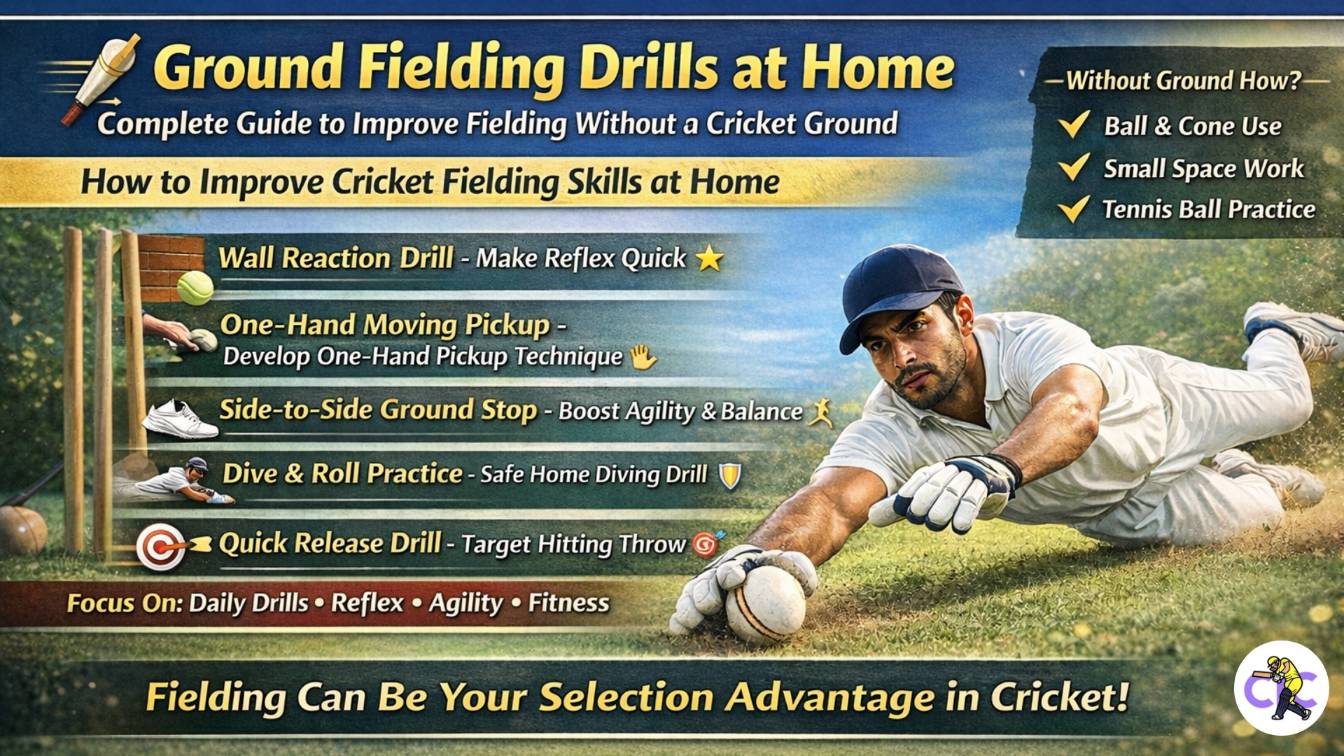
In modern cricket, fielding is no longer a secondary skill. It is one of the most important selection criteria at district, state, and professional levels. A single run-out, diving stop, or direct hit can completely change the momentum of a match.
The best part? You do not need a full cricket ground to improve your fielding. With the right drills, discipline, and daily repetition, you can significantly enhance your ground fielding skills at home.
This detailed guide will explain:
Why ground fielding matters
Technical fundamentals
Step-by-step home drills
Weekly structure
Common mistakes
Fitness support for better fielding
Let’s begin.
Read more: Is Cricket a Risky Career? How CIC Helps Parents Take Informed Decisions
Why Ground Fielding Is Crucial in Modern Cricket
Ground fielding mainly includes:
Quick movement toward the ball
Clean one-hand or two-hand pickup
Maintaining low body position
Fast and accurate throw
Smooth transition from stop to release
At competitive levels, selectors observe:
Body balance while collecting
Speed of release
Throwing accuracy
Agility and reaction speed
Even if a player is average in batting or bowling, exceptional fielding can give them a strong advantage.
Core Technical Basics of Ground Fielding
Before starting drills, understand the fundamentals:
✔ Stay Low
Always bend your knees and lower your center of gravity while collecting the ball.
✔ Head Over the Ball
Your head should be steady and slightly ahead of your body while picking up.
✔ Soft Hands
Avoid rigid hands. Cushion the ball while collecting to prevent fumbles.
✔ Quick Transfer
Move the ball smoothly from pickup to throwing position without delay.
Mastering these basics makes drills more effective.
Detailed Ground Fielding Drills You Can Do at Home
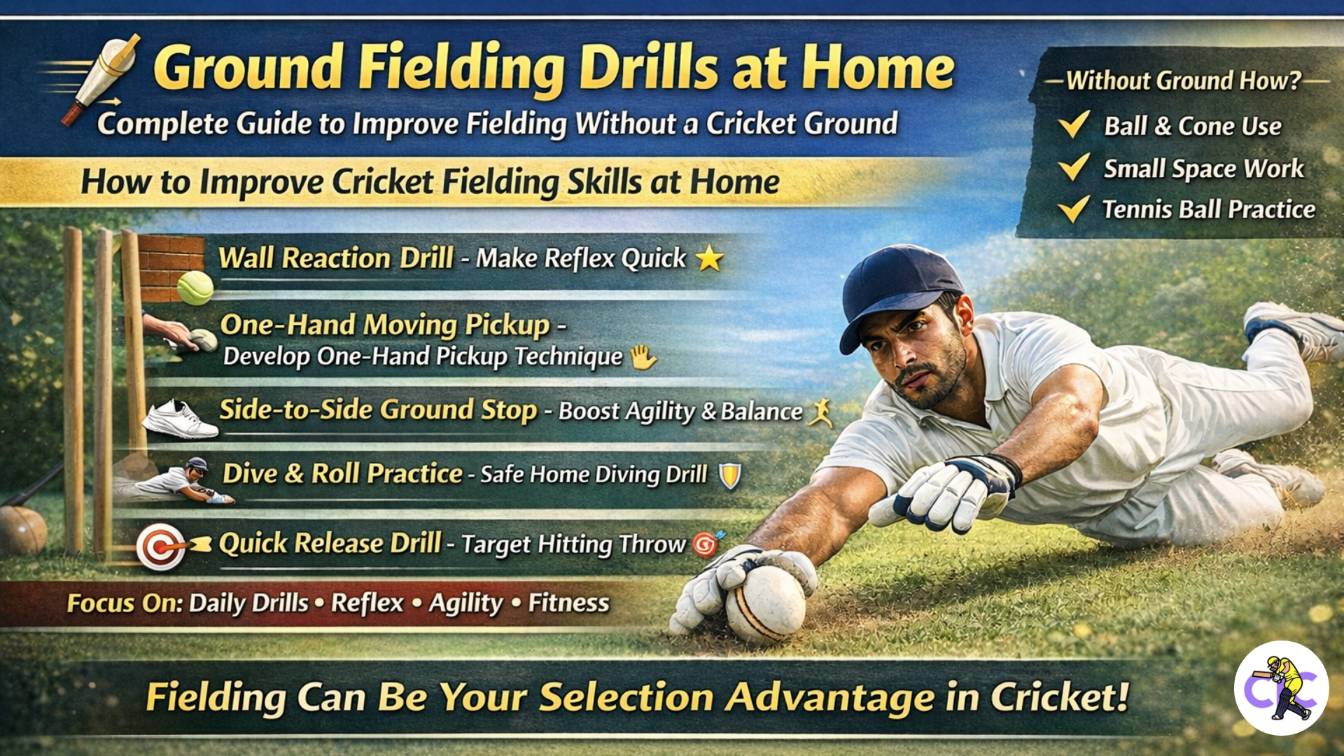
1️⃣ Wall Reaction Rebound Drill (Reflex Development)
This is one of the most effective drills for improving reaction speed.
How to perform:
Stand 6–10 feet away from a wall
Throw a tennis ball at medium speed
React quickly to the rebound
Collect it in a low position
Repeat continuously for 5–10 minutes
Why it works:
Improves reflexes
Enhances hand-eye coordination
Builds quick reaction time
Advanced variation: Throw the ball slightly sideways to simulate unpredictable angles.
2️⃣ One-Hand Moving Pickup Drill (Match Simulation)
This drill simulates real match conditions.
How to perform:
Roll the ball forward
Sprint toward it
Bend low and pick it up with one hand
Simulate a throw immediately
Focus on staying balanced and avoiding stopping completely before pickup.
Benefits:
Improves running pickup
Enhances body coordination
Develops smooth throw transition
Practice both right-hand and left-hand pickups.
3️⃣ Side-to-Side Ground Stop Drill (Agility & Balance)
Lateral movement is essential in ground fielding.
How to perform:
Place two objects 3 meters apart
Shuffle quickly between them
Touch the ground each time
Stay in athletic stance
Add a ball stop at each end for advanced difficulty.
Benefits:
Improves lateral speed
Strengthens legs
Enhances balance under pressure
4️⃣ Rolling Ball Dive & Stop Drill
Diving technique can be practiced safely at home on soft ground or grass.
How to perform:
Ask someone to roll the ball randomly
Move quickly and stop it with your body
Practice both sides
Get up quickly and simulate a throw
If alone, roll the ball against a wall at an angle and react.
Benefits:
Improves anticipation
Builds confidence while diving
Enhances ground coverage
5️⃣ Quick Release & Target Throw Drill
Fielding is incomplete without accurate throwing.
How to perform:
Pick up the ball from the ground
Quickly align your body
Throw at a small marked target on a wall
Focus on accuracy, not power
Practice both overarm and sidearm throws.
Benefits:
Improves throwing precision
Reduces release time
Enhances arm coordination
6️⃣ Figure-8 Movement Drill (Advanced Coordination)
This drill improves movement efficiency.
How to perform:
Place two cones in figure-8 shape
Move quickly around them
Add a ball pickup at the end of each round
Benefits:
Improves foot speed
Enhances directional change
Builds match-like rhythm
🔹 Fitness Support for Better Ground Fielding
Strong fielding requires physical strength.
Focus on:
✔ Lower Body Strength
Squats
Lunges
Wall sits
✔ Core Stability
Planks
Russian twists
Leg raises
✔ Speed & Reaction
Short sprints (10–20 meters)
Ladder drills
Jump squats
A strong lower body and core improve balance during pickups.
Weekly Home Fielding Training Plan
Day 1: Wall reaction + target throw
Day 2: Pickup drill + agility drill
Day 3: Dive & stop + quick release
Day 4: Reaction + sprint work
Day 5: Match simulation movements
Day 6: Mixed session
Day 7: Light recovery & review
Consistency for 4–6 weeks can show visible improvement.
Common Mistakes to Avoid
❌ Standing upright while collecting
❌ Watching the ball late
❌ Delayed throwing motion
❌ Practicing only dominant side
❌ Ignoring fitness
Always practice both left and right sides equally.
Mental Aspect of Fielding
Fielding demands alertness. Stay mentally active:
Stay ready before every ball
Anticipate direction
React instantly
Good fielders are proactive, not reactive.
How Career in Cricket (CIC) Helps in Skill Development
Career in Cricket (CIC) focuses on complete player development, including fielding. CIC provides:
Skill-based improvement guidance
Selection-oriented preparation awareness
Fitness and agility education
Structured career roadmap
The aim is to help players become complete cricketers ready for competitive cricket.
Final Conclusion
Ground fielding can be improved significantly at home with structured practice. You do not need expensive equipment or a large field.
What you need is:
✔ Daily repetition
✔ Correct technique
✔ Agility training
✔ Quick reaction practice
✔ Mental alertness
If practiced consistently, these drills can help you stand out during trials and competitive matches.
Fielding is not optional in modern cricket — it is a selection advantage.
Read more: Poor Background Se Cricketer Kaise Bane? – Complete Practical Guide
Read more: Cricket Me Backup Career Options – Coach, Analyst, Umpire (Detailed Career Guide)